Global Need, Global Reach
Akathisia awareness is reaching new corners of the world. A recent Japanese repost of MISSD resources on X reminds us that the need for accurate akathisia information is global.
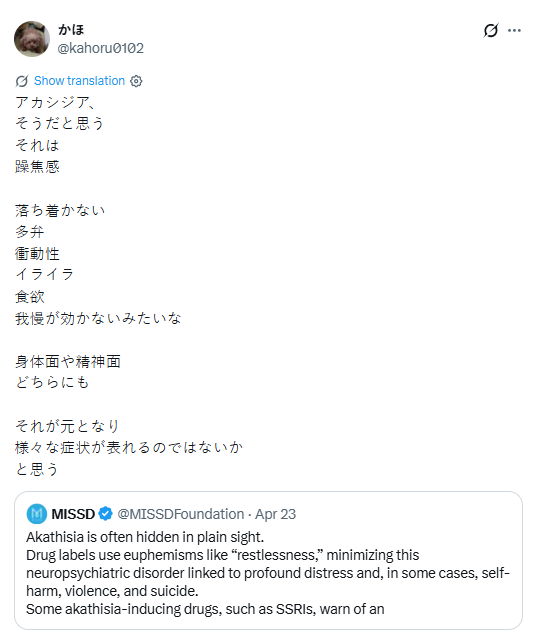
Akathisia awareness is reaching new corners of the world. A recent Japanese repost of MISSD resources on X reminds us that the need for accurate akathisia information is global.
We’re pleased to share our full presentation from the Psychotherapy Networker Symposium, now available on YouTube.
In this session, we address a critical gap in public and clinical awareness: how akathisia—a serious, medication-induced disorder—is often overlooked and also obscured by misleading language in drug labeling and safety communications.
Pharmaceutical labeling and medical education frequently use terms like “restlessness,” which do not adequately convey the severity of akathisia. This can delay recognition and appropriate response.
Similarly, current FDA warnings on SSRIs state that these medications may “increase” suicidal thinking. However, evidence and patient reports indicate that akathisia-inducing drugs can create suicidal thoughts in some individuals—particularly when akathisia is unrecognized and/or mistreated.
This distinction is not semantic. It is a matter of patient safety. In this presentation, we cover:
▶️ Watch the full presentation: https://www.youtube.com/watch?v=5yhubTwnpz4
For additional education, MISSD offers free online courses, public health videos, and the Akathisia Stories podcast—available to clinicians, patients, and families worldwide.
Akathisia is receiving increased media attention this week due to Jordan Peterson’s recent health problems caused by akathisia. Unfortunately, for many, this may be the first time encountering the term.
Healthcare consumers and professionals deserve accurate risk info PRIOR to prescribing and they should specifically be informed of akathisia.
As awareness grows, it is essential that conversations around akathisia remain clear, accurate, and focused on early recognition and appropriate care. Take our courses, listen to the Akathisia Stories podcasts, and see our public health videos at https://www.youtube.com/@MISSDFoundation.
Read the article about his daughter, Mikhaila’s, health update at https://www.themirror.com/news/us-news/jordan-peterson-health-update-daughter-1797074.
MISSD supports a Change.org petition calling for Black Box warnings to explicitly name and describe akathisia—a medication-induced disorder associated with severe distress, suicidality, and preventable harm.
When akathisia is not clearly identified in drug warnings, it is often misunderstood or misdiagnosed. This can delay appropriate intervention and increase risks.
For more than a decade, MISSD has advocated for accurate labeling and education so that patients and clinicians can recognize akathisia early and respond appropriately.
We encourage patients, families, clinicians, and advocates to sign and share this petition:
Sign the petition. Early recognition saves lives.
New reporting from The New York Times raises important questions about how clinical trials are conducted and overseen—and what that may mean for patient safety and informed consent.
Clinical trials are essential, but they do not always capture the full picture of how medications affect individuals in real-world settings. Early warning signs—especially medication-induced effects like akathisia—can be missed or misunderstood. In some previous clinical drug trials, akathisia was miscoded, downplaying the likely cause of suicidality and suicide as adverse drug effects and events.
At MISSD, we emphasize the importance of:
These steps can help prevent serious and sometimes life-threatening outcomes.
👉 Note: This article is behind a paywall. https://www.nytimes.com/2026/04/13/well/fda-clinical-trials.html,
A recent article spotlights important questions about antidepressant use in children. Analyses suggest limited benefit in certain cases, while prescribing rates continue to rise. Other findings highlight the need for careful monitoring and greater awareness of potential risks—especially with longer-term use.
These concerns underscore a broader issue: how we understand and respond to childhood distress. Children and families deserve a full range of support, including evidence-based therapies and non-drug approaches.
The goal is not to dismiss treatment, but to ensure it is measured, informed, and centered on the child.Read the full article at https://www.madinamerica.com/2026/04/questioning-the-prescription-antidepressants-and-the-medicalization-of-childhood/.
We appreciate this article’s intention to share information about antidepressants for older adults and its attention to common side effects such as weight changes, cardiovascular effects, and drug interactions.
However, one serious risk is not addressed: medication-induced akathisia.
Older adults are at higher risk of akathisia and adverse drug effects, making awareness and early recognition especially important. Education about akathisia is essential for safer prescribing and truly informed care. Read more at https://www.aol.com/news/choose-best-antidepressant-older-adults-165900746.html.
We’re encouraged to see increased awareness of prescribed harm and the growing number of lived experiences being shared: https://prescribed-harm.com/
At MISSD, we have amplified similar stories to improve patient safety and deepen understanding of akathisia and related medication-induced harms.
While MISSD focuses on akathisia, it is not the only form of medication-induced harm that can precipitate suicide. Other serious effects may include post-SSRI sexual dysfunction (PSSD), emotional blunting, and loss of emotional responsiveness.
Adverse drug events are among the leading causes of death, yet remain widely under-recognized. Sharing lived experience helps improve recognition, informed consent, and ultimately—saves lives.
A season centered on awareness and reflection reminds us that recognizing suffering early can make all the difference.

At MISSD, we regularly feature and amplify first-person accounts that illuminate the very real risks of adverse med effects—particularly the torment of akathisia and protracted withdrawal syndromes. Lori Daniels’ latest essay, ‘I Can Barely Breathe: The Journey Continues,’ is one such account. She was entangled in a system amid a circle of misdiagnosis—beginning with a coerced introduction to neuroleptics as a teenager and a cocktail of drugs that treated side effects with more side effects.
Her description of ongoing symptoms (akathisia, dystonia, myoclonic jerks, insomnia, and the sense that ‘breathing’ itself must be redefined) aligns with what countless others have reported when attempting to withdraw from long-term psychiatric drug use. Too often, these symptoms are dismissed or misattributed back to the original ‘disorder.’ We are grateful for voices like Lori’s and her full story that can help reduce these avoidable harms.